
My first real backpacking trip, I packed a suitcase. Not even a small one. A hard shell, full size suitcase that I then had to drag up four flights of stairs to a hostel in Lisbon with no elevator, sweating through my shirt, apologizing to everyone I bumped into on the narrow staircase.
That suitcase also got me charged extra at two different budget airlines because it blew past the carry-on weight limit, and I spent half the trip annoyed at having to lug it everywhere instead of just exploring.
Since then I’ve done over a dozen trips with just one backpack, no checked luggage, no rolling suitcase, nothing else. It took some trial and error to get there, including a memorable incident involving three pairs of jeans I never wore once, but at this point I can pack for a two week trip in about twenty minutes flat. Here’s exactly what’s in the bag and why.
Why One Backpack Actually Works Better Than It Sounds
Before I get into the list, the mindset shift matters more than the gear. Most people overpack because they’re packing for every hypothetical situation instead of their actual trip. I used to think what if I need this, and now I think will I actually use this, realistically, more than once.
That single change cut my packing list by almost half.
The other thing that surprised me is how much freedom one bag actually gives you. No waiting at baggage claim, no risk of lost luggage, no struggling up stairs or cobblestone streets with wheels that don’t roll on uneven ground. You can move fast, change plans last minute, and just walk straight off a plane or train without standing around.
The Backpack Itself
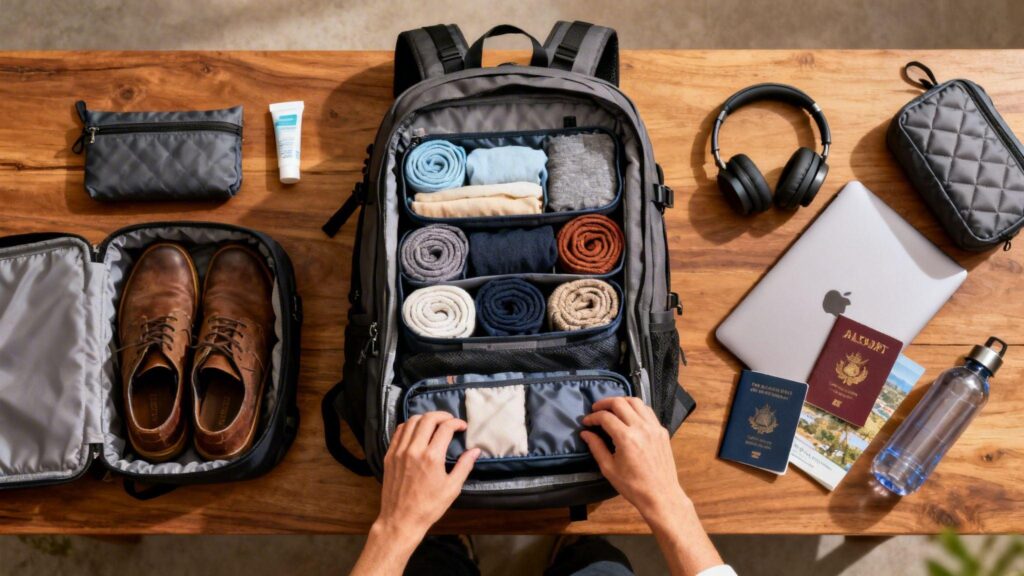
I use a 40 liter travel backpack, specifically the Osprey Farpoint 40, which has been through enough trips at this point that the zippers are starting to show wear but it’s still going strong. The size matters because most airlines, especially budget ones in Europe like Ryanair or Wizz Air, have strict free carry-on dimensions, and 40 liters tends to fit those limits without forcing you to pay extra.
It opens like a suitcase, a full clamshell zip, instead of a top loading hiking pack, which makes a massive difference for actually finding things instead of digging to the bottom every time you need socks.
Clothing: The Part Everyone Overpacks
This is where almost all the wasted space goes for first time backpackers, myself included on that suitcase trip.
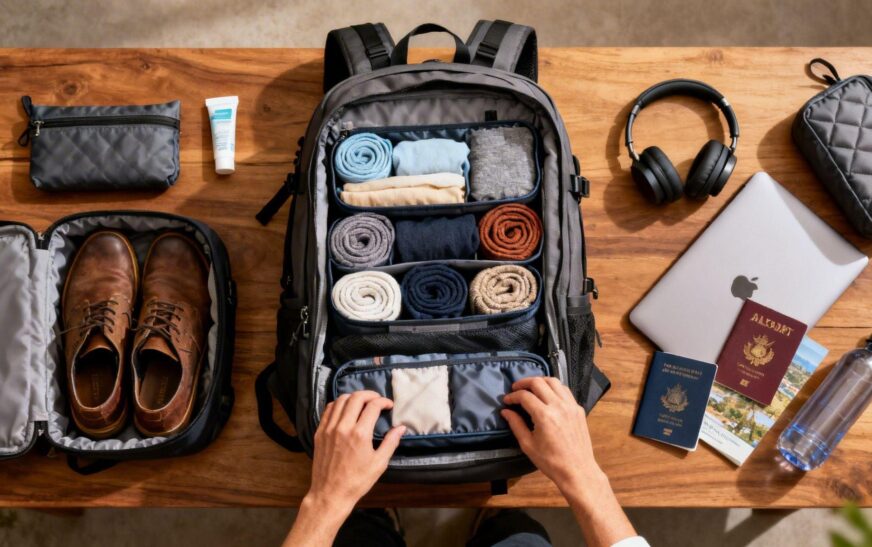
My actual clothing list for a two to three week trip, regardless of length honestly, looks like this. Five t-shirts, mostly merino wool or a quick dry blend since they don’t hold odor the way cotton does. Two pairs of pants, one regular and one slightly nicer for evenings out. One pair of shorts. Seven pairs of underwear and socks, this is the one category I don’t skimp on. One light jacket or fleece, packable down to almost nothing. One rain shell, the packable kind that folds into its own pocket. One swimsuit. One set of sleepwear that doubles as loungewear.
That’s genuinely it for clothes. The trick is doing laundry every five to seven days instead of packing enough to avoid laundry entirely. Most hostels have a laundry service or machines, and if not, a sink wash with quick dry fabric and a hostel balcony or windowsill handles it fine.
Toiletries and Health Stuff
Liquids go in a clear quart size bag to clear airport security without hassle, this part isn’t optional if you’re flying carry-on only.
I keep a small kit with travel size shampoo and body wash, a toothbrush and toothpaste, a small deodorant, sunscreen, and a basic first aid pouch with bandaids, pain relievers, and any prescription medication in its original labeled container. I also always pack a small pack of electrolyte tablets, Liquid IV or similar, since they’ve saved more than one rough travel day caused by dehydration or a bad stomach.
One mistake I made early on was packing full size everything just in case. Travel size containers, refillable silicone ones work great and you just top them off, save a surprising amount of space.
Electronics and Tech
This category has actually shrunk over the years as I’ve gotten more deliberate about what’s genuinely necessary.
My phone does most of the heavy lifting, maps, translation, photos, so I don’t carry a separate camera anymore unless it’s a trip specifically about photography. Beyond the phone, I carry a small portable charger, a universal travel adapter since plug types vary by country and this one thing has saved me more than once, and a set of wired earbuds since they’re harder to lose than wireless ones and don’t need their own charging case.
I also keep a Kindle instead of physical books, which sounds like a small thing but over a multi-week trip it’s saved enormous amounts of weight and space compared to my early trips where I’d pack two or three paperbacks just in case I finish the first one.
Documents and Money
A small zippered pouch holds my passport, a printed copy of my passport photo page kept separate from the actual passport, travel insurance details, and a backup debit card kept in a different part of the bag than my main wallet, in case one gets lost or stolen.
I use a no foreign transaction fee card, the specific one varies depending on what’s available where you bank, but it’s worth checking before any trip since foreign transaction fees add up fast over a few weeks. I also keep a small amount of local cash for places that don’t take cards, which is more common than you’d expect even in fairly developed countries.
The Smaller Stuff That Actually Earns Its Spot
A few things that seem minor but have proven themselves useful enough to keep packing every single trip. A packable daypack that folds into a tiny pouch, used constantly for day trips so I’m not carrying the full 40 liter bag around all day. A reusable water bottle, since refilling beats buying plastic bottles constantly and a lot of airports now have refill stations past security. A microfiber travel towel, which dries fast and takes up almost no space, useful for hostels that don’t provide towels. A small padlock for hostel lockers. And earplugs plus a sleep mask, which have saved more nights of sleep in noisy hostel dorms than almost anything else on this list.

Step by Step: How I Actually Pack the Bag
Once I’ve decided what’s going in, the order it goes into the bag matters almost as much as what’s on the list.
Heavy items go closest to your back and near the bottom, things like the toiletry kit and shoes, so the weight sits close to your body instead of pulling backward.
Clothes get rolled, not folded. Rolling saves real space compared to folding and also makes it easier to see what you’ve got without unpacking the whole bag.
Packing cubes go in next. I use a basic three piece set, one for tops, one for bottoms, one for underwear and socks, which keeps everything separated and means I’m not digging through a jumbled pile every morning.
Anything I’ll need during the flight or travel day, the charger, a snack, the Kindle, goes in the top compartment or a separate small bag I can access without opening the whole pack.
Shoes go around the edges or in a separate shoe bag to keep dirt off everything else, and I only ever pack two pairs, one for walking and one slightly nicer pair, never more.
A Real Example: My Last Two Week Trip Through Eastern Europe
For a recent two week trip through Prague, Budapest, and Krakow in early autumn, the entire bag weighed in right around 18 pounds packed, well under most airline carry-on weight limits. I did laundry twice during the trip, once at a hostel in Budapest with a self service machine, once at an actual laundromat in Krakow.
I never once wished I’d packed more. I did, on one cold evening, wish I’d packed a slightly warmer base layer, which is now a permanent addition to the list for any trip heading into shoulder season.
Common Mistakes to Avoid
Packing for worst case scenarios instead of your actual itinerary wastes the most space. Most just in case items never get used. Check the actual weather forecast and your actual planned activities instead of guessing broadly.
Bringing too many shoes is an easy trap. Shoes are heavy and bulky relative to almost anything else in a bag. Two pairs covers nearly every situation.
Overpacking toiletries instead of buying small amounts there adds unnecessary weight. Most countries have pharmacies and convenience stores. You don’t need to bring a six week supply of anything.
Skipping the practice pack causes problems later. Pack the bag a few days before the trip, wear it around the house or on a short walk, and adjust. Finding out a bag is uncomfortable at the airport is too late.
Forgetting that laundry exists is the single biggest reason people overpack clothes. Five to seven days of clothing plus a laundry plan beats three weeks of clothing every time.
Final Thoughts
That dragged suitcase up four flights in Lisbon was honestly the best thing that could’ve happened early on, because it forced me to rethink the whole approach instead of just continuing to overpack out of habit. One backpack sounds restrictive until you actually try it, and then it just feels like freedom, less to carry, less to lose, less to think about, more time actually paying attention to the trip instead of the luggage.
If you’re planning your first trip like this, don’t try to nail the perfect list on the first attempt. Pack what feels reasonable, pay attention to what you actually used and what just sat there unused, and adjust for the next trip. That’s basically how this whole list came together in the first place.
How to Strengthen Family Bonds in a Digital Age
We were all sitting at the dinner table a couple years ago, all four of us physically present, and I looked up and realized every single person had a phone either in hand or sitting face-up next to their plate. My youngest was watching something with one earbud in. My husband was answering a work email. I was scrolling Instagram. Nobody was talking.

That image stuck with me longer than it should have. We were together, technically, the way a family is supposed to be at dinner, but we were about as connected as four strangers waiting at a bus stop.
That dinner is what got me to actually look at how much our devices had quietly taken over the spaces that used to just be family time. Not in some dramatic, screens-are-evil way, I still use my phone constantly and don’t think that’s the problem. The actual problem was that nobody had drawn any lines, so the phones just filled every gap by default.
Since then we’ve made some real changes, some of which worked great and some of which flopped completely. Here’s what’s actually held up.
The Problem Isn’t Screens, It’s the Absence of Boundaries
I want to get this out of the way because a lot of advice on this topic treats technology like the enemy, and that’s not really accurate or useful. Phones, group chats, video calls, these things have made staying close to family genuinely easier in plenty of ways. My mom and I talk more now than we did before texting existed.
The actual issue in our house wasn’t that we had phones. It was that we’d never decided when phones were okay and when they weren’t, so they just defaulted to always-on, including during the exact moments that used to naturally build closeness, like dinner, car rides, and lazy weekend mornings.
Once I reframed it that way, as a boundaries problem instead of a technology problem, the fixes got a lot more obvious.
Step 1: Pick a Few Non-Negotiable Phone-Free Times
We didn’t try to overhaul everything at once, that always backfires for us. Instead we picked two specific windows and made them phone-free, no exceptions, no “just checking one thing.”
Dinner was the first one. Phones go in a basket on the kitchen counter before anyone sits down, mine included. The first week felt oddly tense, like something was missing, which honestly told me how dependent we’d all become on having a screen as a backup activity. By week three it felt normal, and dinner conversations actually started going somewhere instead of fizzling out in two minutes.
The second window was the first thirty minutes after anyone got home from school or work. No scrolling, no checking notifications, just actual hellos and a real conversation about the day before everyone scattered to their own devices.
Step 2: Use Technology on Purpose, Not by Default
This was a bigger mental shift than I expected. Instead of treating screen time as this vague blob to minimize, I started asking whether a given use of tech was actually building connection or just filling silence.
A shared family photo album through Google Photos, where everyone adds pictures, that’s tech building connection. Four people independently scrolling four different apps at the same table, that’s tech filling silence. Same devices, completely different outcome.
We started using a family group chat on WhatsApp specifically for sharing small stuff, a funny thing that happened, a photo from someone’s day, instead of saving every update for a big info-dump conversation that never quite happens because everyone’s tired by the time it would. That one change made the in-person time feel less like catching up on missed news and more like actually being together.
Step 3: Make a Plan for the Genuinely Hard Parts, Like Teenagers and Phones
My oldest is a teenager now, and pretending phones aren’t a huge part of her social life would be unrealistic and honestly a little unfair. Teens use phones to maintain friendships, which matters to them the same way our friendships matter to us.
What’s worked better than an outright phone ban is being specific about which moments are protected, dinner, the first half hour home, family outings, rather than trying to police her phone use generally. She still gets frustrated sometimes when a friend group chat is buzzing during dinner, but she’s also stopped fighting the rule itself because it’s consistent and it’s not personal, it applies to all of us equally, including the adults.
We also started doing a once-a-month thing where she picks an activity completely unrelated to screens, bowling, a hike, baking something complicated, and we all do it together. It’s not about banning technology, it’s about making sure there’s still regular, dedicated space where it’s simply not part of the equation.
Step 4: Use Video Calls to Actually Close Distance, Not Just Check a Box
My parents live a few states away, and for a while our calls were these quick, surface-level check-ins, mostly logistics, barely any real conversation. Switching some of those calls to video through FaceTime made a bigger difference than I expected, especially for my kids, who light up so much more when they can actually see their grandparents instead of just hearing a voice.
We also started a recurring Sunday afternoon video call, same time most weeks, instead of calling whenever it happened to come up. Having it scheduled means it actually happens consistently instead of sliding by for two or three weeks at a stretch.
Step 5: Build Small Rituals That Don’t Involve a Screen at All
This ended up mattering more than I expected going in. We started a Friday night thing, nothing elaborate, just a board game or a puzzle after dinner, completely separate from the no-phones-at-dinner rule, just an actual planned activity that requires everyone’s attention.
Games like Codenames or a basic jigsaw puzzle on the kitchen table have become this weirdly reliable source of real conversation. Something about working on a shared task side by side gets people talking more naturally than sitting across from each other trying to make conversation happen on command.
A Real Look at How This Plays Out Now

A typical week in our house now includes phone-free dinners every night, the first thirty minutes home from school or work with phones away, a Friday game night, a scheduled Sunday video call with my parents, and a shared family photo album that everyone contributes to throughout the week.
It’s not perfect. Some weeks the Friday game night gets skipped because someone’s exhausted. The phone basket at dinner occasionally gets a quiet exception for something genuinely urgent. But the structure means things come back, instead of slowly fading the way they were before we made any of this intentional.
Common Mistakes to Avoid
Treating it as an all-or-nothing crackdown. Banning phones entirely usually creates resentment and doesn’t actually teach anyone healthier habits, it just removes the device for a while until the rule quietly falls apart. A few protected windows work better than a blanket ban.
Applying rules to kids that the adults don’t follow. My daughter calls this out instantly, and she’s right to. If phones are away at dinner, that includes the adults’ phones too, no exceptions for work emails.
Assuming closeness will happen automatically just because everyone’s home. Being in the same house doesn’t equal being connected, that dinner table moment taught me that the hard way. Connection needs some kind of structure or it gets crowded out by default habits.
Ignoring what technology does well. Cutting out video calls or group chats entirely in the name of “real connection” actually backfired when we tried it briefly. Some tech genuinely strengthens family bonds, especially across distance, the goal isn’t elimination, it’s intention.
Not adjusting as kids get older. What worked for my kids at six and nine needs tweaking now that one of them is a teenager with a real social life that partly exists online. Rigid rules that don’t account for that tend to just generate conflict instead of connection.
Final Thoughts
That dinner table moment, four people together and completely disconnected, was honestly the wake-up call we needed. Nothing about our technology use was unusual or extreme, it had just quietly filled every gap because we’d never decided where the boundaries should be.
None of what changed things for us required giving up our phones or pretending technology is the enemy. It just took a few protected windows, a little more intention about how we used tech to connect instead of just fill time, and some small recurring rituals that don’t involve a screen at all. If you’re noticing the same thing we noticed at that table, start with just one phone-free window. Dinner is probably the easiest place to begin, and you’ll likely notice the difference faster than you’d expect.