
Just some examples of complete AdSense-friendly articles that you can write with:
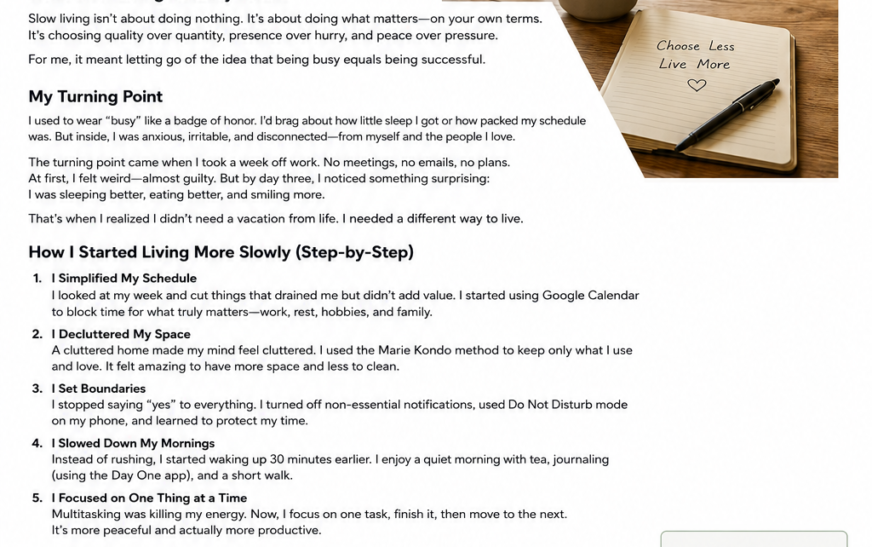
Slow Living Is Not Laziness → doing less in a way that actually led to my happiness
Just a few years back, I had what appeared to a hectic schedule, from the time my eyes opened upon awakening. Checking emails before even getting out of bed, scrolling through social media between breakfast bites and bouncing from one task to another until 10pm. On paper, I looked productive. In reality, I was exhausted.
The weirdest thing was that, whenever I ended up sitting idle, I would feel guilty about not doing anything. Work seeped into my life like the natural flow of earth, since if I paused in which to drink a cup of tea, it was work time. You heard that, because if I saw a movie I got anxiety against what had not been done. Rest felt like wasted time.
Then something unexpected happened. I first slowed down after a particularly stressful time in my life, not because it was fashionable at the time, but just because I couldn’t cope anymore.
What I learned transformed how I live my life. It didn’t make me lazy — doing less. Made me happier, calmer, and ironically more productive.
The Problem With Being Always Busy
I used to think being busy meant you were doing things very successful.
My schedule was packed. My reminders were there all over my phone. My to-do list never ended.
Similar Posts Whenever anyone asked me how I was doing, my default answer was always “Busy”.
Initially, it felt like an accomplishment. Later, it became a burden.
I noticed several warning signs:
Constant mental fatigue
Difficulty concentrating
Irritability over small things
Poor sleep quality
Not taking pleasure in things I normally enjoy
The more I put into each day, the less present I was.
I realized I was never really living my life. I was rushing through it.
What Does It Mean To Live Slow
There are a ton of misconceptions about slow living, and one of the biggest ones is that it involves doing nothing.
That’s not what I experienced.
Slow living isn’t laziness. It is deciding what matters and focusing on it instead.
It is being deliberate, not reactive to everything that comes your way.
I used to think that slow living looked like:
Going on walks without checking my phone
Making dinner without being on a stream
Not taking on unnecessary commitments
Less distracted family time
Single tasking
It wasn’t that I was doing less out of not wanting to.
I was doing less because in order to do more important things better.
The Coincidental Returns I Observed
The first couple of weeks sucked.
I was telling myself I need to do more.
However, after a while I started seeing results.
Better Focus
My productivity went through the roof when I gave up multitasking.
I stopped switching to another 5 things and focused on one thing at once.
Ironically, I finished work faster.
Improved Mood
I was less rushed and less stressed.
Simple moments became enjoyable again.
The morning cup of coffee was not just another chore. It was a calm moment in my day.
Stronger Relationships
I Loved It When I Stopped Checking Notifications So Frequently!
Conversations felt more meaningful.
Before I did, friends and family noticed the change in me.
More Gratitude for Mundane Life
Surprising was the extent of beauty that I had been missing.
Sunsets, the early hours before everyone is up, conversations around the table that lasts until we forget what time it really was and home fried chicken—these, always.
I was just going too fast to notice them.
Small Things That Helped Me Slow Down
On a positive note, you don’t have to get rid of everything and live in a cabin off the grid or quit your job to practice slow living.
There were just a few tweaks that made all the difference for me.
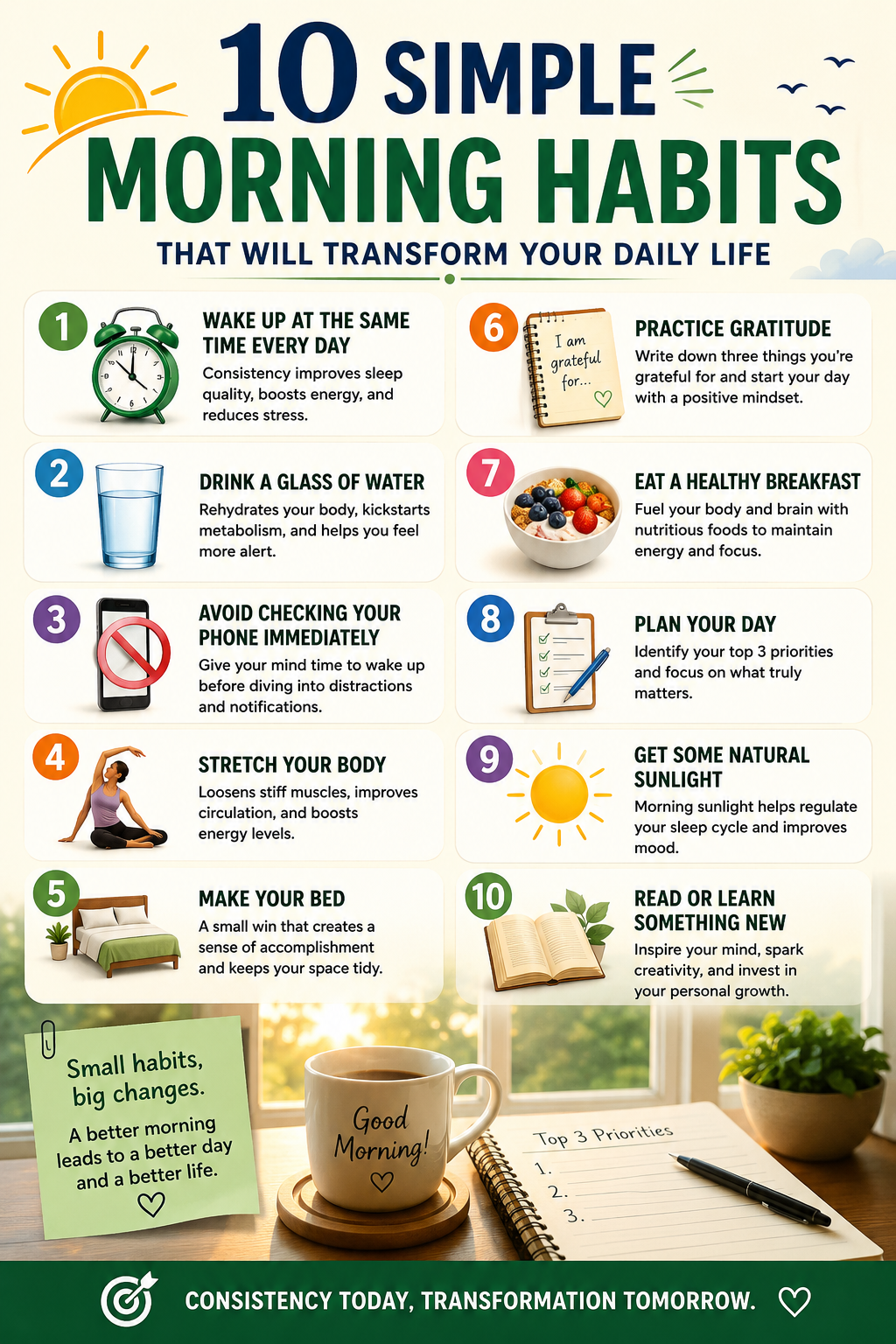
1. Leave Your Phone Off In The Morning
This was the trickiest thing for me to create a habit out of.
I used to check notifications as soon as I woke up.
These days I go phone free for the initial 20 to 30 mins of waking up.
There are times I stretch, drink water and in some instances just sit still.
I can actually tell the difference this makes for my stress levels.
2. Limit Your Daily Priorities
I created long to-do lists.
Every day finished with work left to do and disappointment.
I have three key areas of focus now.
Anything extra is a bonus.
Almost immediately that one, simple change reduced overwhelm.
3. Schedule Empty Time
Initially, it felt wrong leaving spaces on my calendar.
Raiding demanded that every minute be filled, it disallowed moments to rest or adapt.
I now make a conscious effort to schedule breaks in between and not have commitments so closely placed.
These quick breaks help me re-energize.
4. Reduce Digital Noise
My phone would vibrate repeatedly.
From emails to social media alerts to news updates and shopping promotions, the interruptions never ceased.
I turned off most notifications.
I make use of scheduling tools like Google Calendar and the built-in Screen Time or Digital Wellbeing options on my devices to track usage.
Fewer distractions mean more attention for what matters
5. Practice Single-Tasking
Multitasking often feels productive.
In actuality, it can create a mental clutter.
When reading, I just read.
When eating, I just eat.
At work, I have only one project on my mind.
Just this one habit made these both more effective and pleasurable.
What I Did Wrong with Slow Living
My journey wasn’t perfect.
There are a few mistakes that I committed here.
Mistake # 1: Attempting to Fix Everything at Once
On the other hand, what I initially did was to try a complete lifestyle change.
It lasted about a week.
The slow living approach is most effective when changes are made in increments.
Start small.
One habit is enough.
Mistake # 2: Sleeping in, Think this as a laziness
It took a while to shed this belief.
A lot of the time, people feel bad when they are doing nothing.
I certainly did.
I came to learn that rest is an enabler of productivity.
This is not a negative of work. This is normal, it is part of a healthy rhythm.
Mistake #3: Comparing My Life to Other People
Social media can make each other many of us appear like we are living such jazzed up lives and going on fad after fad.
Every time I measured my more languorous life against the highlight reel of someone else, I felt guilty.
That’s because happiness means something different for everyone.
Slow living is not a trend;
It’s about making a life that you will enjoy.
Real life Slow Living Examples
Not everyone is going to do slow living in the same way.
A parent might cut down on weekend activities to spend more quality time at home.
For example, a business owner may quit checking emails after dinner.
Device-free study windows, for example: a student.
For example, a remote worker will find themselves stepping out for regular breaks in fresh air rather than being glued to a desk all day.
It’s not about doing less for once in a while it is all of this at times.
It’s being deliberate with what you give your energy to.
How to Begin with Slow Living Today
To see how you like living a slower lifestyle, start with these simple steps:
Step 1: Choose One Thing In That Feels Way Too Much
Pick one area (work, socialization, technology all of them),
Don’t tackle everything at once.
Step 2: Delete one task which you really do not need
Ask yourself:
Why do I have to do this?
Sometimes the answer is no.
Step 3: One Daily Pause
Take ten minutes.
Sit outside.
Read a book.
Drink tea.
Walk around the block.
Protect that time.
Step 4: Focus on Presence
Whatever you’re currently doing give it your full attention.
A little true present even only a few permissible moments makes surprisingly energizing.
Step 5: Be Patient
Slow living isn’t a destination.
It’s an ongoing practice.
Some days will feel rushed.
That’s normal.
The goal isn’t perfection. The goal is awareness.
How Doing Less Made Me Happier
My biggest learning here is, happiness is not always about adding more.
Or maybe it comes in simply removing what no longer serves you.
Less was more, which helped me see more.
More peace.
More gratitude.
More connection.
More enjoyment in ordinary moments.
Embracing slow living didn’t make my life perfect.
I had deadlines, responsibilities, and busy days.
What changed is the way I no longer connect my value to getting booked.
I have had clarity that activity and fulfillment are not the same thing.
And for me, slowing down life became one of the most productive decisions I ever made—not because it lead to more things getting done, but because in that slowness my life started being worth living while living.
Personal/experience writing style/casual writing with little to no linking suitable for blogs concerned about lifestyle /health/wellness/personal development/adSense.
Planning a Road Trip That Everyone in the Family Actually Enjoys
Three hour into what should have been a 14-hour drive to the Grand Canyon and my eight year old had asked are we there yet for what seemed like the fortieth time,My teenager was plugged in with earbuds and hadn’t spoken since Phoenix, armed her phone screen bright as day (and at least she still texted me sonar emojis), while my husband and I were squabbling low-key about whether we’d missed our turn. Nobody was having fun. And this was supposed to be the best day of summer.

That trip certainly reinforced something I learned long ago just because you throw everyone in a car and head in the general direction of home, it doesn’t mean your road is going to be paved with wonderful family memories. You need real planning the kind that realizes a six-year-old, a sixteen-year-old and two exhausted adults all want different things out of eight hours in a minivan.
We’ve since taken what must have been a dozen road trips gone from never again to, honestly, something my kids actually ask for. Here’s what actually changed.
The Major Mistake That Nearly Every Family Make (Me Included For Years!!
We played road trip like we were accountants calculating a delivery route. A to B, Mapping out shortest distance and time between stops. And if you’re moving furniture, that works fine for you. It was not made for humans it does not work even for small ones with bladders the size of a walnut and a similarly short attention span.
And then the breakthrough that turned it all around for us: the drive is part of the vacation, not a hurdle standing between you and your vacation. This idea is how you plan and once it goes into that everything else gets easier.
Step 1: Get Everybody’s Feedback Before You Plan Anything
This sounds obvious but this is the step that many miss. I really sat down with the kids before our last trip to the coast and asked them what they wanted out of it. He said to me about half way through, I just want to stop somewhere with a pool. That’s it. That was his whole request. Easy to give him.
My teenager needed wifi, and at least for part of the drive so she could stay in touch with her friends by texting. Also easy.
Without asking, you only guess, and from my experience, the guess is always wrong as your plan is built around what would work for you not them.
Short pitch on how to do this: Go around the table one night after dinner and ask everyone what one thing it would take for this trip to be it for them. Write it down. You are obviously not obligated to comply with every request, but you would find out that the majority of them is rather cheap and easy.
Step 2: Pro-build-in Way Fewer Stops Than Would Seem Necessary
The biggest change I made? I would plan one gas stop every three to four hours, this is about how long a tank lasts. I schedule a stop every 90 minutes two hours maximum, regardless of the fact that the tank is only half full.
Doesn’t need to be a big production It can sometimes be merely a rest stop with a vending machine too. Occasionally I’ll check a whacky roadside attraction off the list on Roadside America or Atlas Obscura we once made a stop at a giant ball of twine in Kansas and two years later, my kids are still talking about it. A literal ball of twine. You don’t need Disneyland caliber stops; you just need some time to spread out.
The old rule: Any drive over two hours (never a good time to hit the road); planned middle-of-the-road stop: No questions asked.
Step 3: Select a route versus just a destination
Like, the only thing I thought about for a long time was where we were going. These days I think just as hard about how we get there.
Road trippers was one I discovered a while back that lets you plot your route and see things like tourist sites, restaurant options, and weird roadside points of interest along the way it’s saved us more than once when we’d finally had full up with fast food (ps: drive-thrus only have so many chairs) and needed something to eat in where we wouldn’t end up eating off the floor. Google Maps is great for navigation (although I’ll also use Waze or Maps.me depending on what part of the world I’m in), but it’ll also never be able to tell me that hidden little diner I should hit 40 minutes off my route. So I lean on apps like road tripprers or just do a search at night before it gets dark enough your phone won’t work anymore anyways
Explore locations that are in between, unless you are very time-cattle; routes that aren’t fast but route through somewhere actually interesting. Example: we once added an hour and a half to our drive by going through Sedona instead of taking the flat highway alternative, and it made a dull travel day into one of the highlights of the whole trip.
Step Four: Your actual plan for entertainment (not, “Bring your tablet”)
But tablets and phones are okay, I won’t even pretend they’re not. Yet screens alone age quickly, and you will reach a moment in time when the battery dies or anyone receives carsick from taking a look at a display for almost any period of time (this occurs more than individuals realise).
What’s worked for us:
A few super simple car games that you don’t need any supplies for: the license plate game, 20 Questions, etc.
A family listen along your household can enjoy together. We listened to the first Percy Jackson book on a road trip and even my husband, who tells me he hates “kid books” enjoyed it.
Throwing a bag of some new (cheap) toys or activity books that only gets used in the car so it stays fresh
Pre-downloaded playlists (or podcasts) since cell service disappears in many beautiful places where you’ll want to listen to music
The audiobook surprised me most of all. It also gave us something to discuss together in our family as opposed to four people doing four different things in the same car.
Step 5: Snacks Are More Important Than You Realize.
I used to get just whatever was easiest at the gas station. Chips, candy, the usual. A pair of sugar-crashed kids and a car ninety minutes later is not even worth thinking about in terms of fun.
At this point, though, I pack a cooler with actual food fruit cut up, string cheese, sandwiches. It requires more effort in preparation but it results in less tantrums and less unplanned pit stops because someone “needs” a chocolate bar right now.
I even have a separate tiny bag of treat snacks for variety, because you really can’t completely deprive kids of the fun food on a road trip and still be healthy. Balance, not deprivation.
STEP 6: ALLOW THE SCHEDULE ROOM TO BREATHE
And my plans for the Grand Canyon got derailed in one part, because I had it on a (we will only spend 1 hour at _ to hour schedule. Drive time, check-in time, dinner reservation- all set. A person could be embarrassed with iffiness, apparently any delay (and there is usually a delay) contributed to everybody desired we were “behind.”
Since then I build buffer time in everywhere. If I believe it’ll take five hours to make a drive, then I tell the family that it may be six; and I will not schedule anything so close that it is against arrival time. It eliminated almost all of the stress from our travels.
REAL EXAMPLE: OUR LAST TRIP (HOW WE DID IT)
This past summer we drove ten or so hours from Texas to Colorado, not stopping mind you (kidding, we stopped).
It took us two days of driving instead of one long haul
With this being our first stop on day one, about four hours into the trip we pulled over at a little water park, to shake the bugs from their legs and cool off.
Cheap hotel with pool (got it on Booking. The data (which is up until October 2023) from Bespoke is filtered for “pool” as an amenity on zillow.
Day two explored a scenic overlook my husband discovered on Roadtrippers, a completely unplanned stop that was ultimately added to our itinerary because it was “on the way”
Showed up with the rest of the crew which is quite a feat as it normally consists of some sort of frazzled mess.
It wasn’t a complicated plan. It simply recognise that the act of driving needed to be pleasurable, not just tolerated.
Common Mistakes to Avoid
Overpacking the itinerary. If there is something from tick, tock all day long every day no one gets a break and road trips require time put into them.
Not catering to teenagers because they’re “easy” Teens can seem like less work, as they plug headphones in and go quiet (which is sooo nice) but that quiet isn’t content. Ask them what they want too.
Not testing your devices and chargers before leaving. This we learnt the hard way when a batery died on hour two and the charger was also broken. Every trip, everything, I test the night before now.
Overlooking the family gathering preceding booking. A five-minute call almost eliminates disappointment later.
Neglecting medication, allergy information or simple first aid. Not a glamorous thing to plan for, but a mini first aid kit (and a list of allergies and medications) have saved us from really disastrous moments on more than one occasion.
Final Thoughts
This is not any sort of complicated stuff. The changes are mostly minor more frequent breaks, more student input around what they need, a less regimented schedule, better snacks. But that’s kind of the point. A good road trip is not about some grand plan, but the quick reminder that it’s no individual site nor the company of others in a car its to put people together as much as where you drive unto.
None of our recent trips has been without a hitch. Someone gets car sick at times, plans are still changed. But nobody’s saying “are we there yet” every 10 minutes anymore, and that honestly feels like a victory.